

Northampton Man Receives Eight Years in Federal Prison |
Justice served: Behind the Northampton man's eight-year federal prison sentence. |
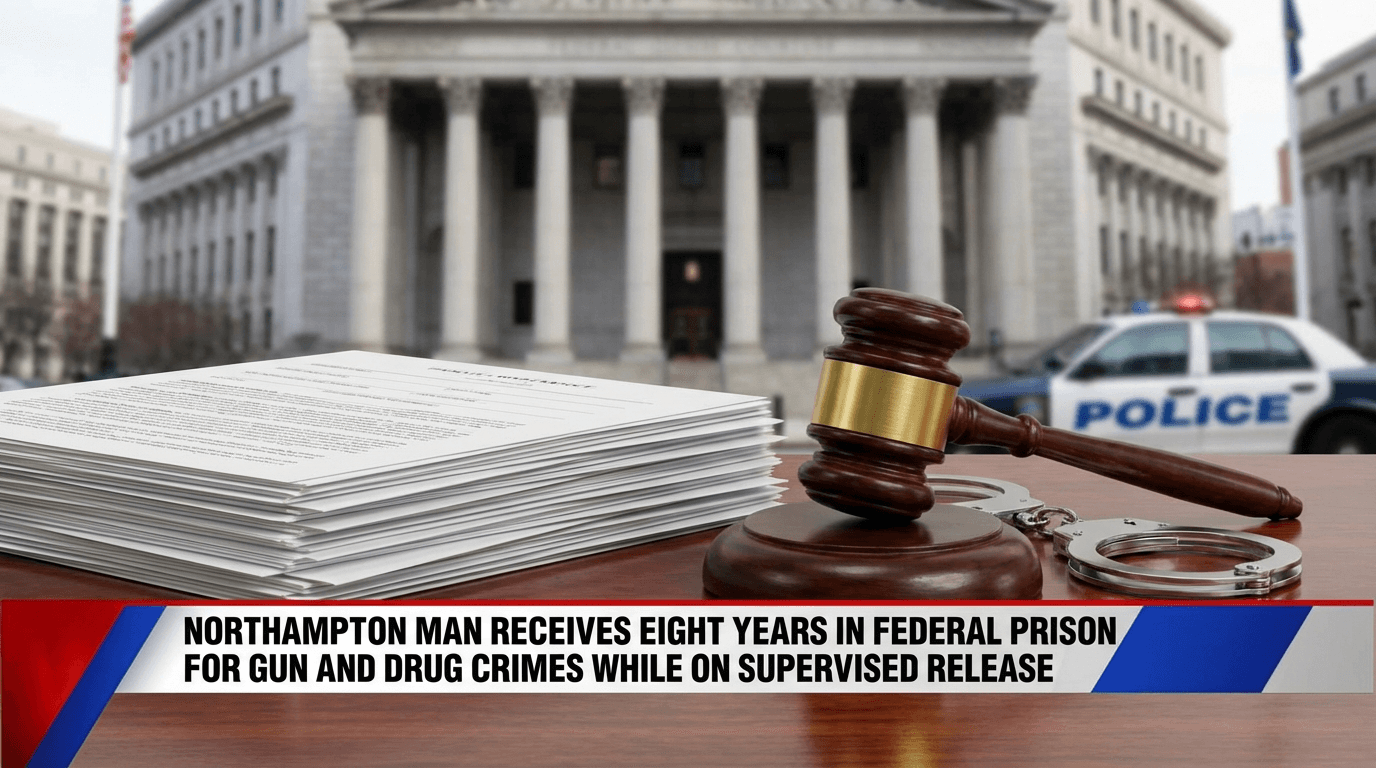
Northampton Man Receives Eight Years in Federal Prison for Gun and Drug Crimes While on Supervised ReleaseA Northampton man with a history of firearms violations will spend the next eight years in federal prison after police found him brandishing a loaded weapon in a hotel lobby while carrying crack cocaine and heroin. Gabriel Lebron, 35, received his sentence yesterday in federal court in Springfield from Judge Mark G. Mastroianni. The judge imposed seven years for the firearm and narcotics charges, plus an additional year for violating his supervised release from a previous federal conviction. The sentences will run consecutively, meaning Lebron must serve the full eight years. He will face three years of supervised release after completing his prison term. Lebron pleaded guilty in September 2025 to being a felon in possession of a firearm and ammunition, and to possessing crack cocaine and heroin with intent to distribute. Hotel Lobby Incident Leads to ArrestThe case began on April 9, 2025, when someone called 911 to report a man waving a gun in the lobby of the Howard Johnson hotel in Hadley. Police responded quickly to the emergency call and found Lebron in the lobby. Officers discovered he was carrying a Jimenez Arms Model JA 25, a .25 caliber semi-automatic pistol. The weapon was loaded with five rounds of ammunition, including one round already chambered and ready to fire. This detail is significant because a chambered round means the gun could be fired immediately without any additional action. Beyond the firearm, Lebron also possessed 10 individual packages of crack cocaine, commonly called snap caps in street terminology, and two bundles of heroin. The quantity and packaging of the drugs indicated he intended to sell them rather than use them personally, leading to the distribution charge. Police took Lebron into custody at the scene without incident. Pattern of Firearms ViolationsWhat made Lebron's arrest particularly serious was his criminal history and current legal status. At the time of the hotel incident, he was supposed to be under federal supervision following a previous conviction. In 2023, a federal court sentenced Lebron to 27 months in prison for possessing a loaded ghost gun in Vermont. Ghost guns are privately made firearms that lack serial numbers, making them difficult for law enforcement to trace. The weapon in that case included a laser sight and multiple rounds of ammunition. That Vermont conviction came with three years of supervised release, a period during which Lebron was required to follow specific conditions and restrictions. Federal supervised release functions similarly to probation, with requirements such as regular check-ins with a probation officer, restrictions on firearm possession, and prohibitions on criminal activity. By possessing a firearm and drugs in April 2025, Lebron violated the terms of his supervised release while still serving that three-year period. This violation resulted in the additional one-year sentence that will be served after his seven-year term for the new charges. Understanding the Charges and SentenceFederal law prohibits anyone with a felony conviction from possessing firearms or ammunition. This restriction applies regardless of where the original conviction occurred or how much time has passed. Lebron's prior Vermont conviction made it illegal for him to possess any firearm. The felon in possession charge carries a maximum penalty of 10 years in federal prison. Data from the United States Sentencing Commission shows that the average sentence for this offense is approximately five years. Lebron's seven-year sentence exceeds this average, likely reflecting the combination of his prior firearms conviction, the loaded nature of the weapon, and the presence of drugs indicating ongoing criminal activity. The drug charges added to the severity of his case. Possession with intent to distribute crack cocaine and heroin are serious federal offenses, particularly when combined with firearm possession. Federal prosecutors often pursue enhanced penalties when defendants mix drugs and guns, viewing this combination as especially dangerous to public safety. Consecutive Sentencing ExplainedJudge Mastroianni ordered Lebron's sentences to run consecutively rather than concurrently. This distinction matters significantly for how much time he will actually serve. Consecutive sentences stack on top of each other. Lebron must complete his seven-year sentence for the gun and drug charges before beginning his one-year sentence for the supervised release violation. This results in a total of eight years in federal prison. Had the judge ordered concurrent sentences, both terms would run at the same time, and Lebron would serve only seven years total. Judges typically order consecutive sentences when they want to emphasize the seriousness of multiple violations or when a defendant commits new crimes while already under court supervision.
|


Multi-Agency InvestigationThe case involved coordination between several law enforcement agencies. The Hadley Police Department responded to the initial 911 call and made the arrest. The Massachusetts State Police assisted with the investigation. The federal Bureau of Alcohol, Tobacco, Firearms and Explosives took the lead on the firearms aspects of the case. Thomas Greco, Special Agent in Charge of the ATF's Boston Field Division, worked with United States Attorney Leah B. Foley to announce the sentencing. Assistant United States Attorney Steven H. Breslow of the Springfield Branch Office prosecuted the case, presenting evidence of both the new charges and the supervised release violation. Federal vs State JurisdictionThis case proceeded through federal court rather than state court for several reasons. The felon in possession charge falls under federal firearms laws that apply nationwide. Additionally, Lebron's status on federal supervised release from his Vermont conviction meant federal authorities already had jurisdiction over his conduct. Federal sentences typically require defendants to serve at least 85 percent of their prison term, with limited opportunities for early release. This differs from some state systems that may offer more extensive good time credits or parole options. After completing his eight-year prison sentence, Lebron will begin his three-year supervised release period. During this time, he will face strict conditions including regular meetings with a probation officer, restrictions on travel and association, and prohibitions on possessing firearms or using illegal drugs. Any violation of these conditions could result in additional prison time. |



0 Comments
Join the conversation
Be the first to comment
Share your thoughts above.